/// Share this article
If you are looking for a website redesign in Bangalore, you will probably get quotes ranging from a Rs.10,000 to several lakh of rupees – like Rs.2 lakh, Rs.5 Lakh or even upto Rs.15 lakh
That part is easy.
The difficult question is:
What exactly are you redesigning?
Because a website redesign can mean very different things.
Sometimes a business genuinely needs a completely new website.
Sometimes the existing website is healthy and only needs a visual refresh.
Sometimes the design looks old, but the website has valuable Google rankings, URLs, backlinks, content and conversion pathways that should be preserved.
And sometimes the biggest problem isn’t the design at all.
It is the technology underneath it.
Or the URL structure.
Or performance.
Or security.
Or a broken enquiry journey.
Or years of accumulated technical debt.
I’ve worked with websites where the correct recommendation was to rebuild almost everything.
I’ve also seen websites where rebuilding the entire thing would have been the wrong decision.
That’s why I don’t think website redesign should begin with:
“How much will a new website cost?”
It should begin with:
“What is the existing website already doing for the business, and what are we trying to improve?”
That distinction can save you a surprising amount of money.
Quick answer: How much does a website redesign cost in Bangalore?
As a broad working range, a website redesign in Bangalore can look something like this:
| Type of redesign | Typical starting range |
|---|---|
| Visual refresh / new design skin | ₹35,000+ |
| Professional redesign with UX, responsive design and performance improvements | ₹60,000+ |
| SEO-sensitive redesign / migration | ₹1.5 lakh+ |
| Complex redesign, replatforming or custom functionality | ₹2 lakh–₹5 lakh+ |
| Large custom platforms / web applications | ₹5 lakh+ |
They are useful starting points for understanding scope.
A five-page website that simply needs a modern visual treatment is fundamentally different from a ten-year-old website with hundreds of indexed URLs, existing Google rankings, CRM integrations, custom forms, old plugins, backlinks, analytics history and a business that depends on organic leads.
Calling both of them “website redesigns” hides an enormous difference in complexity.
And that is exactly why two companies can quote ₹50,000 and ₹3 lakh for something that sounds like the same project.
The question isn’t necessarily which quote is expensive.
The question is:
What problem is each company actually solving?
A website redesign is not the same thing as building a new website
This is probably the most important thing I would tell a business owner before starting a redesign.
A new website starts with a relatively clean slate.
A redesign doesn’t.
Your existing website may already have:
- Google rankings
- indexed pages
- backlinks
- internal links
- content
- branded search visibility
- historical authority
- enquiry pathways
- analytics data
- conversion data
- integrations
- customer familiarity
- URLs referenced elsewhere on the internet
- years of accumulated search-engine signals
Some of these assets may be obvious.
Many aren’t.
That’s why I prefer to investigate an existing website before deciding what should actually be rebuilt.
And I’ve learned this lesson partly by investigating what happens when websites are changed without treating the old website as an asset.
What can actually go wrong during a redesign?
Here’s a real example.
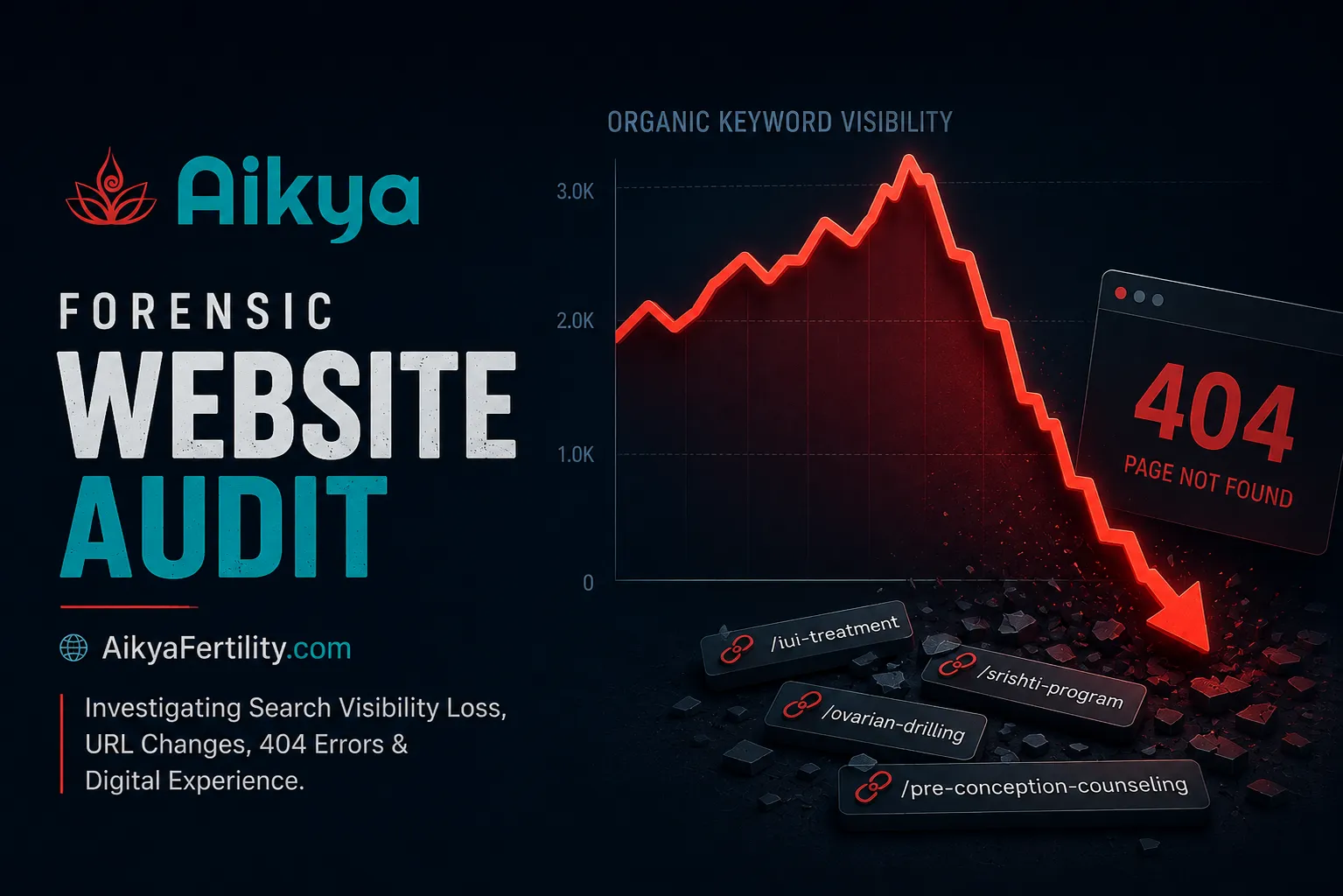
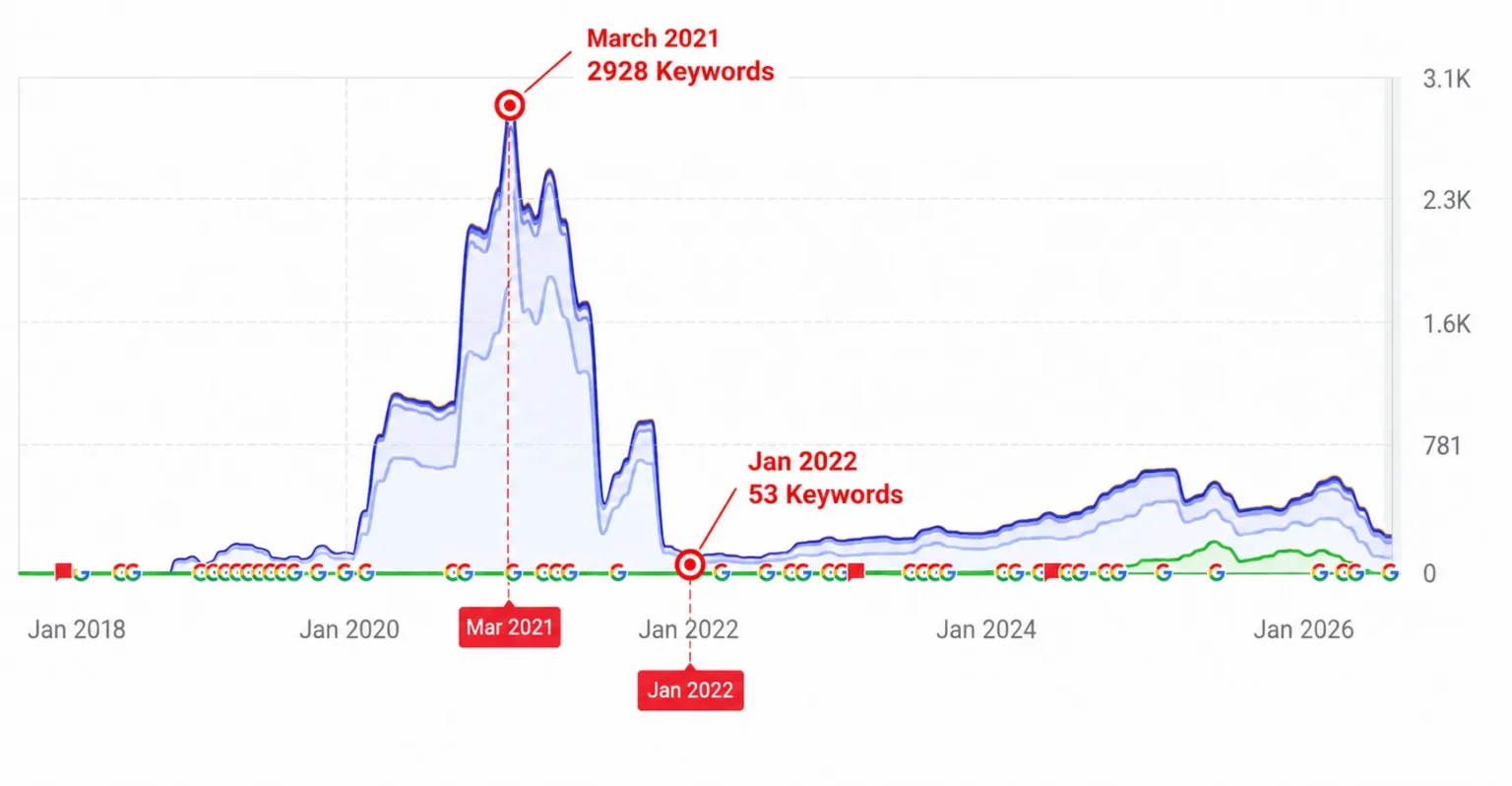
In our forensic investigation of Aikya Fertility’s website history, we reconstructed several years of the domain’s history rather than looking only at its current homepage.
The historical data showed something remarkable.
In March 2021, the website was ranking for:
2,928 tracked keywords
Including:
- 18 keywords in the Top 3
- 81 keywords in the Top 10
- 211 keywords in the Top 20
- 1,139 keywords in the Top 50
By February 2022, the tracked keyword count had fallen to:
53
That’s approximately a 98.2% reduction in the measured Top-100 keyword footprint.
The Top-10 footprint fell from 81 keywords to 5.
That doesn’t prove that the redesign alone caused the collapse.
And I deliberately don’t make that claim in the forensic investigation.
But the historical evidence showed substantial website and URL-architecture changes during the period between the high point and the collapse.
That is precisely the sort of thing we need to investigate before redesigning a website.
Before redesigning, ask: why does the website need redesigning?
There are at least four very different situations.
1. The website looks old
The business is healthy.
The SEO is healthy.
The technology is healthy.
The conversion path works.
The website simply looks like it was designed several years ago.
In this situation, you may not need a completely new website.
You may just need a new visual system.
2. The website looks fine but performs badly
Now we’re dealing with something different.
Perhaps:
- pages are slow
- mobile UX is poor
- forms don’t work properly
- navigation is confusing
- conversion paths are weak
- technical SEO is poor
- accessibility has been neglected
- the CMS has become difficult to maintain
A visual redesign alone won’t solve those problems.
3. The website is fundamentally difficult to maintain
Perhaps the website has accumulated:
- too many plugins
- conflicting plugins
- outdated dependencies
- unnecessary page builders
- custom code nobody understands
- abandoned integrations
- security problems
Now the technology itself may justify a rebuild.
4. The website has become disconnected from the business
This is the most interesting one.
The business may have evolved dramatically.
The website hasn’t.
The company may now be premium, specialised and highly trusted, while the website still communicates like a generic small business.
At that point, redesigning the website isn’t really a design exercise.
It is a business communication exercise.
Sometimes the website only needs to shed its skin
I use a simple analogy for this.
If a snake is healthy but its skin is old, you don’t replace the snake.
You change the skin.
The snake is still the same snake.
A website can be exactly the same.
If the existing:
- URL structure
- content
- rankings
- information architecture
- conversion paths
- integrations
- backend
are healthy, but the visual interface looks dated, there may be no reason to throw everything away.
Give it a new skin.
Keep what works.
Improve what doesn’t.
Release the old skin.
This sounds obvious.
Yet rebuilding everything is often the easiest commercial recommendation for an agency. And I have seen this happen almost every time.
It isn’t necessarily the best recommendation for the client.
An 18-year website history shows why “old” doesn’t automatically mean “bad”
Our investigation of KLE CBA Hubli’s website history went back approximately 18 years.
The website had gone through multiple generations.

The 2008 version had an implementation that relied heavily on Flash-era technology.
By 2017, the site had moved toward HTML-based rendering, improving its crawlability and indexability.
Historical search visibility subsequently climbed from roughly 5 tracked keywords to nearly 100.
But sometimes a redesign really does require changing the architecture
The opposite mistake is assuming:
“We’ll keep everything because it already exists.”
That can be just as dangerous.
Suppose your existing website has:
/services/web-design.html
and you redesign it into:
/web-design/
That isn’t merely a design decision.
You’ve changed a URL.
And URLs can matter.
Google’s own guidance on site moves recommends preparing a URL mapping, configuring redirects from old URLs to new ones, updating internal links and monitoring the old and new URLs during the move. Google also recommends keeping redirects for as long as possible, generally at least a year.
This is why I get nervous when someone says:
“Don’t worry, we’ll just launch the new website and Google will figure it out.”
Maybe.
Maybe not.
A professional redesign should not rely on “maybe.”
A URL isn’t just a URL
The KLE CBA investigation provides another useful example.
Over its history, the website’s URL architecture changed several times.
For example, older URLs included structures such as:
/about.html
/academics.html
/placements.html
Later implementations used different structures such as:
/klecba/about_us
and subsequently:
/home/about
and later still:
/About/KLE+Society
The investigation also identified temporary redirects and other historical URL behaviour.
At one point, after another substantial redesign and URL change, historical visibility fell from approximately 100 tracked keywords to 1.

Again, the investigation does not claim that the redesign or any single footer/link/URL change caused that decline.
There were multiple changes in play.
That’s precisely the point.

The primary domain was redirecting to the /klecba location, and the historical audit recorded that redirect as a 302 temporary redirect rather than a permanent 301 redirect.
This is exactly the sort of detail that a normal visitor would never notice.
They type the domain.
The website opens.
Everything seems fine.
But from a technical perspective, a website redesign should be much more deliberate.
Don’t redesign by looking at the homepage alone
This is another mistake I see frequently. As a client, you submit your website redesign request with a few web designing companies.
A typical volume-based web design company opens your website’s existing homepage.
They look at it for five minutes.
They say:
“Yes, this needs a redesign.”
Perhaps it does.
But that’s not enough investigation.
An existing website should be examined from multiple angles.
For example:
Search
- What keywords does it rank for?
- Which pages bring organic traffic?
- Which pages have historically performed well?
- Are there valuable long-tail pages?
- Are there pages nobody visits anymore?
URLs
- How many URLs exist?
- Which URLs are indexed?
- Which URLs are linked externally?
- Which URLs should remain?
- Which URLs should be merged?
- Which URLs should redirect?
Content
- What content actually attracts visitors?
- Which pages generate enquiries?
- What content has accumulated backlinks?
- What content is outdated but still valuable?
Conversion
- Where do enquiries originate?
- Which forms work?
- Which phone numbers are clicked?
- Which calls-to-action perform?
- Where do visitors abandon the journey?
Technology
- CMS
- themes
- plugins
- frameworks
- integrations
- custom code
- dependencies
- hosting
- security
Performance
- loading performance
- responsiveness
- visual stability
- mobile experience
Google’s Core Web Vitals focus specifically on loading performance, responsiveness and visual stability, with LCP, INP and CLS being the current core metrics.
Accessibility
A redesign should also consider whether people with disabilities can actually use the website.
W3C’s Web Accessibility Initiative provides internationally recognised guidance around accessible web design and development.
Security
A redesign is also an opportunity to examine whether the underlying system is secure and maintainable.
OWASP’s 2025 Top 10 includes risks such as broken access control, security misconfiguration, software supply-chain failures, injection and insecure design.
In other words:
The homepage is only one room in the building.
Before demolishing the building, you should probably inspect the plumbing.
A beautiful website can still have serious problems
Our investigation of Touchstone Interiors’ website audit produced another useful lesson.
The website looked modern.
It was visually polished.

But the investigation found several issues underneath the presentation.
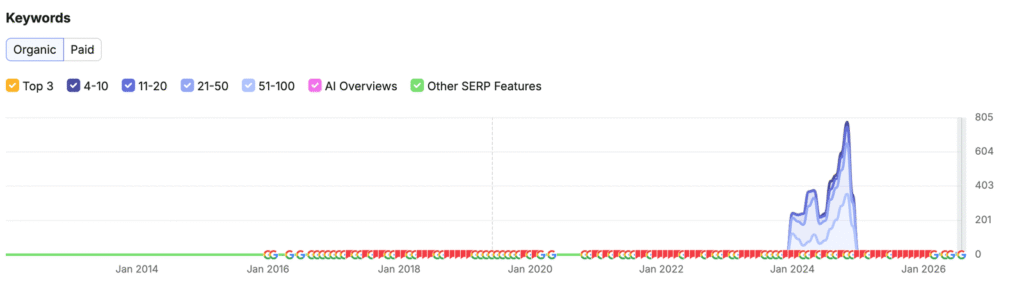
The historical data showed approximately 780 ranking keywords around November 2024 before a dramatic decline.
The investigation also found concerns around:
- generic positioning
- weak contextualisation of projects
- a broken or questionable conversion path
- generic metadata
- unclear service architecture
- technology/dependency considerations
One particularly unusual finding involved the site’s “Get Started” call-to-action pointing toward a phone number publicly associated with another organisation.

The number attached to that button is:
8884476667
That number is publicly associated with Ameyya Institute, an organisation offering IT-related training.
Ameyya’s own Google business profile lists the same number as its contact number.

That’s not a colour problem.
That’s a business problem.
A portfolio isn’t automatically a sales tool
Touchstone also provides another lesson.
The business had more than 350 projects.
That’s impressive.
But a portfolio containing hundreds of images isn’t necessarily communicating why a prospective customer should choose the company.
A potential customer doesn’t merely want to see:
“Look at our projects.”
They want to know:
- What kind of projects do you specialise in?
- Are you suitable for my project?
- What problem did you solve?
- What was the challenge?
- What did the client want?
- What did you deliver?
- Why was your approach different?
- What does this say about your capability?
The difference is subtle.
But commercially, it’s enormous.
Don’t redesign by looking at the homepage alone — look at the history
The historical keyword graph from the Touchstone investigation is therefore more useful than another pretty screenshot.
“The homepage tells you what the company wants visitors to see today. Historical search data tells you something about what the website was actually doing for the business.”
So what should a website redesign actually accomplish?
This is where I think the conversation needs to move beyond “modern web design.”
A successful redesign should make the website better at doing what the business needs it to do.
That could mean:
- generating more inquiries
- communicating premium positioning
- making services easier to understand
- increasing trust
- improving mobile usability
- reducing friction
- improving performance
- improving accessibility
- simplifying administration
- making content easier to manage
- protecting existing search visibility
- creating better conversion pathways
- supporting expansion into new markets
- integrating better with the company’s operations
The visual design is important.
But it is only one part of the equation.
Your website should be the mirror image of your business
I don’t mean the website should literally copy your office, showroom or visiting card.
I mean that someone should be able to understand why your business is different by experiencing your website.
If your business is premium, the website should communicate premium.
If your business is technically sophisticated, the website should communicate competence.
If your business is highly trustworthy, the website should communicate trust.
If your competitive advantage is speed, the website should make that obvious.
If your advantage is expertise, the website should demonstrate expertise.
The website should communicate:
Why should I choose this business instead of the alternatives?
Not:
Why should I choose this website?
That’s a surprisingly important distinction.
Find the X-factor before redesigning the website
When I redesign a website, I don’t want to begin by asking:
“What color should the buttons be?”
I want to understand the business first.
What makes the business successful?
What makes customers choose it?
What makes competitors successful?
What makes the best companies in that niche successful?
Sometimes it’s:
- brand
- product quality
- expertise
- pricing
- reputation
- location
- customer service
- speed
- reliability
- technology
- convenience
- a unique offer
Once we identify that X-factor, we can ask a much more useful question:
How should the website communicate that X-factor?
That’s where design becomes strategic.
Study the leaders — don’t blindly copy them
One of the best ways to approach a redesign is to study websites belonging to businesses that are already winning in the same category.
Not because we want to copy their colours.
Not because we want to clone their homepage.
Instead, we want to understand:
- What is their X-factor?
- How quickly do they communicate it?
- How do they establish credibility?
- What does the visitor see first?
- How is information organised?
- How do they move visitors from discovery to confidence?
- How do they create a conversion moment?
- What content attracts search traffic?
- What technology supports the experience?
- Which parts of their approach could be adapted to our client’s business?
In other words:
Don’t reinvent the wheel when you can understand why the wheel works.
A website should move people from discovery to confidence to conversion
A good ‘website redesign’ isn’t just a collection of pages.
It should create a journey.
Discovery
The visitor finds you.
Perhaps through:
- social media
- a referral
- an advertisement
- a QR code
- your physical location
- a branded search
- AI chats
Understanding
They quickly understand:
- who you are
- what you do
- who you serve
- where you operate
Confidence
They see:
- expertise
- evidence
- results
- testimonials
- projects
- credentials
- useful information
- transparent communication
Conversion
They know exactly what to do next.
- Call
- Enquire
- Book
- Buy
- Request a quote
- Schedule a consultation
A web redesign should remove unnecessary friction between these stages.
Colour is part of the redesign — but it isn’t decoration
Colour psychology is often treated like a Pinterest exercise.
It shouldn’t be.
The colour system should support the business’s positioning.
A hospital, luxury interior designer, children’s brand, fintech company and industrial B2B manufacturer don’t necessarily need to communicate the same emotional qualities.
The colours should work with:
- brand identity
- audience expectations
- accessibility
- readability
- contrast
- conversion elements
- physical branding
- social media
- packaging
- signage
The website shouldn’t look like it belongs to one company while the physical business, Instagram account and brochures belong to another.
Brand consistency matters.
The website is one part of the brand experience.
The best redesign may be fixing the existing website
This sounds strange coming from a web design company.
But sometimes the correct answer is:
Don’t rebuild it yet.
We’ve investigated websites where the first step should be fixing what already exists.
That could involve:
- correcting technical SEO
- repairing broken links
- removing unnecessary dependencies
- improving performance
- fixing forms
- correcting mobile UX
- improving information architecture
- resolving security problems
- cleaning up plugins
- fixing indexing problems
- improving content
Only after doing that investigation should we decide whether a rebuild is justified.
Sometimes redesign isn’t even the first problem
Our investigation of Balaji Neuro Hospital’s website audit is an extreme example of why this matters.
The website had a long digital history dating back to 2013.
There was a significant redesign around 2018.
Later, the website developed a number of serious integrity and maintenance problems.
The investigation eventually found hundreds of gambling, casino and betting-related pages appearing on the healthcare domain.
There was also evidence of an unexpected external gambling link in the site’s source, alongside other problems including an unstable appointment journey.
Historical search visibility fell from approximately 277 tracked keywords in June/July 2025 to 9 in August 2026.
Again, the investigation deliberately does not claim that the gambling pages alone caused the ranking collapse.
But something much more fundamental can be said:
The website had an integrity and maintenance problem that needed attention before anyone started talking about making it prettier.

Should you keep WordPress or change technology?
There is no universal answer.
I don’t believe in choosing technology because:
“Everyone uses WordPress.”
Or:
“This new framework is trending.”
Or:
“Our company specialises in this CMS.”
The technology should serve the business outcome.
Sometimes WordPress is the right choice.
Sometimes another CMS is better.
Sometimes a custom application is justified.
Sometimes a simple website needs almost no CMS complexity at all.
And sometimes the existing technology is perfectly capable of doing the job.
The question should be:
What technology gives this particular business the best balance of performance, flexibility, maintainability, security, cost and independence?
Not:
“What technology do we want to sell?”
Future-proof doesn’t mean maintenance-free
No website is truly maintenance-free.
Software changes.
Browsers change.
Dependencies change.
Security vulnerabilities emerge.
Third-party services change APIs.
Businesses themselves change.
So when someone promises:
“This website will never need maintenance.”
I’d be suspicious.
A better goal is:
Build a website that doesn’t create ‘unnecessary’ maintenance.
That means reducing:
- unnecessary plugins
- unnecessary dependencies
- fragile integrations
- undocumented custom code
- vendor lock-in
- complicated workflows
- technology nobody understands
Future-proofing is less about predicting the future and more about reducing unnecessary ways the future can break the website.
You should not have to remain dependent on your web developer
This is something I feel strongly about.
A website should belong to the business.
The client should know:
- where the domain is
- where the hosting is
- how to access the website
- how to access the CMS
- who owns the accounts
- what third-party services are connected
- what software/licences are being used
For a simple brochure website, handover may be extremely straightforward.
For a sophisticated custom dashboard, there may be training involved.
But the objective should still be ‘independence.’
I think of training and handholding almost like the initial free services you receive with a new car.
You need some support to understand the machine.
After that, you can choose what you want:
- maintain it yourself
- hire another company
- continue with the original developer
- use a combination of all three
The original developer may have an architectural advantage because they know how the system was built.
But that doesn’t mean the client should be trapped.
What happens when we discover a major problem halfway through a redesign?
This is another reason website redesign pricing can be difficult to predict.
Suppose we start investigating an existing website and discover:
- a serious SEO problem
- a broken integration
- hundreds of obsolete URLs
- security issues
- a database problem
- a fragile custom application
- a dependency that is no longer supported
What happens?
The worst possible approach is to quietly fix it and send the client a larger invoice later.
The better approach is to stop.
Explain:
What we found.
Why it matters.
What options exist.
What each option costs.
What happens if we don’t fix it.
The client may then decide to:
- fix the existing system
- change the redesign approach
- reduce scope
- increase the budget
- postpone the issue
- do nothing
That’s their decision.
A professional redesign shouldn’t turn unexpected technical discoveries into silent scope creep.
Why do website redesign quotes vary so much?
Because “redesign” doesn’t describe the entire problem.
One company may be pricing:
New homepage + 10 pages + mobile responsive design.
Another may be pricing:
Website audit + UX strategy + content restructuring + new design system + development + SEO migration + URL mapping + redirects + performance optimisation + analytics + testing + launch monitoring.
Both may call it:
Website redesign.
They’re not selling the same thing.
That’s why comparing quotes purely by page count can be misleading.
We don’t price websites simply by the number of pages
A 30-page website can be easier than a 10-page website.
Why?
Because those 30 pages may be straightforward content pages.
The 10-page website might contain:
- complex forms
- API integrations
- booking systems
- CRM integration
- custom calculators
- dynamic content
- multilingual functionality
- advanced search
- payment systems
- custom dashboards
So instead of asking:
“How much do you charge per page?”
I’d rather ask:
“What problem are we trying to solve?”
Then price the complete problem.
What actually increases the cost of a website redesign?
The major cost drivers usually include:
Existing website complexity
Older websites can contain years of accumulated technology and content.
Number of URLs
More URLs mean more migration planning, testing and redirect work.
SEO sensitivity
If the existing website receives significant organic traffic, the redesign requires considerably more care.
UX strategy
A website that needs genuine user-journey redesign requires more strategic work than simply replacing colours and fonts.
Content
Writing, restructuring, editing and migrating content can become a major part of the project.
Custom functionality
Booking systems, dashboards, calculators, portals and integrations increase development complexity.
Performance
Improving performance may require architectural changes rather than image compression alone.
Security
A compromised or poorly maintained website can require investigation before redevelopment.
Integrations
CRM, WhatsApp, payment gateways, analytics, marketing automation, booking platforms and other services all add complexity.
Testing
A serious redesign needs testing across:
- desktop
- mobile
- browsers
- forms
- links
- redirects
- analytics
- SEO
- performance
- integrations
The larger the business dependency on the website, the more expensive it becomes to get the redesign right.
What should you budget for a website redesign?
A useful way to think about budget is by business requirement rather than page count.
If you only need a visual refresh
Budget:
₹35,000+ onward.
Suitable when the underlying website is healthy and you mainly need:
- modern UI
- responsive improvements
- new typography
- colour refresh
- better spacing
- updated visual hierarchy
This is the “new skin” category.
If you need a proper professional redesign
Budget:
₹60,000+ onward.
This could include:
- UX improvements
- responsive design
- improved information architecture
- conversion-focused layouts
- better visual hierarchy
- performance improvements
- CMS improvements
- improved forms and CTAs
If the existing website has significant SEO value
Budget:
₹1.5 lakh+ onward.
Now you’re not just designing.
You’re potentially dealing with:
- URL mapping
- redirects
- content migration
- internal links
- metadata
- canonicalisation
- XML sitemaps
- indexing
- Search Console
- analytics
- historical SEO signals
- post-launch monitoring
Google specifically recommends preparing URL mappings, redirecting old URLs to their corresponding new URLs, updating internal links and monitoring both old and new URLs during site moves.
If you’re rebuilding the technology as well
Budget:
₹3 lakh+ onward.
This is where you might be:
- changing CMS
- changing architecture
- rebuilding integrations
- developing custom functionality
- restructuring content
- improving security
- redesigning UX
- migrating SEO assets
- rebuilding the frontend/backend
If you’re building a custom platform
Budget:
₹5 lakh+ onward
At this point, calling it simply a “website redesign” may not even be accurate.
You could actually be building a web application or digital platform.
Should you redesign your website if it already ranks well?
Not necessarily.
This is where I would be particularly cautious.
If your existing website is generating:
- inquiries
- organic traffic
- sales
- bookings
- leads
- repeat visitors
then don’t change things merely because the website looks old.
Investigate first.
Preserve what works.
Improve what doesn’t.
There is a huge difference between:
“This website looks old.”
and:
“This website is no longer helping the business.”
The first may require a visual redesign.
The second may require something much deeper.
What should you ask a web design company before accepting a redesign quote?
I’d ask these questions.
1. Have you investigated my existing website before recommending a rebuild?
If they haven’t, ask why they’re already certain you need a rebuild.
2. What happens to my existing URLs?
Ask for a clear answer.
3. Will you prepare a URL mapping?
This is particularly important for SEO-sensitive websites.
4. Will you implement redirects?
Don’t accept vague language like “SEO will be taken care of.”
Ask exactly what happens.
5. Will you check Google Search Console before and after launch?
If organic visibility matters to your business, this should be part of the process.
6. What happens to my existing content?
Don’t assume every old page should simply disappear.
7. What happens to pages that don’t have an exact replacement?
This requires judgement.
8. Will you investigate existing backlinks and high-value pages?
A redesign should know what it is potentially throwing away.
9. What technology are you recommending — and why?
The answer should relate to your business.
10. Will I own the domain, hosting, accounts and website?
You should know the answer before the project begins.
11. What happens if we discover a major problem?
Get the process for unexpected findings in writing.
12. What happens after launch?
Ask whether the project includes:
testing
monitoring
bug fixing
SEO monitoring
training
handover
And understand exactly what happens after the included period ends.
Should website maintenance be included?
There is no universal answer.
Some websites genuinely need ongoing maintenance.
Others barely need it.
A simple brochure website may require very little intervention after a proper handover.
A sophisticated web application obviously requires more attention.
The important thing is transparency.
You should know:
- what is included
- for how long
- what isn’t included
- what future maintenance costs
- whether you can use another provider
Maintenance should be a service you choose, not a mechanism used to keep you permanently dependent on your developer.
Do you need a detailed website audit before getting a redesign quote?
Ideally, yes.
But there is a practical complication.
A serious forensic audit can take hours or even several days depending on the website.
For a complex site, I may need to examine:
- Search Console
- Analytics
- rankings
- URLs
- content
- backlinks
- technology
- CMS
- plugins
- integrations
- performance
- security
- conversion paths
- internal linking
- historical website versions
There isn’t one universal audit template that works for every website.
A five-page local business website and a 2,000-URL healthcare website should not be investigated in exactly the same way.
For that reason, detailed audits are not always separately charged during the enquiry stage.
A practical high-level assessment can often establish whether a rebuild appears justified.
The deeper forensic work comes once the project is properly engaged.
Why we don’t hand every enquiry a complete redesign blueprint
There’s another practical reality of the web design and development industry.
Some businesses approach multiple agencies and request detailed audits from each.
They then combine the recommendations and take the resulting unified specification to the cheapest developer they can find.
That happens.
So there is a balance.
You should receive enough information to understand:
- what appears to be wrong
- what needs improvement
- what options exist
- why the project may cost what it costs
But a free enquiry shouldn’t necessarily become a several-day consulting engagement.
The objective is to establish trust and make an informed decision — not to give away an entire implementation blueprint before the project even begins.
The most important question isn’t “How much does redesign cost?”
It’s:
“What is the redesign supposed to accomplish?”
If the answer is:
“Make the website look modern.”
That’s one project.
If the answer is:
“Increase qualified enquiries from Bangalore.”
That’s another.
If the answer is:
“Reposition our company as a premium provider.”
That’s another.
If the answer is:
“Move from our old CMS to a more maintainable platform without losing our Google visibility.”
That’s another.
If the answer is:
“Turn our website into the primary digital sales channel for the business.”
That’s a much bigger project.
Same word:
Website Redesign.
Completely different problems, and costs.
Website redesign cost vs website value
I don’t think a ₹2 lakh website is automatically better than a ₹50,000 website.
Nor is a ₹50,000 website automatically a bargain.
The right question is:
What value is the website expected to create?
Suppose a ₹60,000 website generates only a handful of enquiries.
Now suppose a ₹2 lakh website becomes a major source of qualified leads and supports a high-value service.
The second website may be dramatically cheaper relative to the value it creates.
That’s why I prefer to price the problem being solved rather than simply selling pages.
A redesign should not destroy what already works
This is perhaps my strongest rule.
Preserve what is working.
If a page ranks well, investigate it before deleting it.
If a URL has valuable backlinks, preserve its value.
If a particular service page generates enquiries, don’t redesign it blindly.
If visitors are already familiar with a certain navigation pattern, don’t change it simply to make the interface look more fashionable.
If a form works, understand why it works before replacing it.
Redesign should mean:
better.
Not merely:
different.
And after launch, the work isn’t necessarily over
A redesign isn’t successful simply because someone says:
“The new website is live.”
The launch should trigger another period of observation.
Monitor:
- Search Console
- rankings
- traffic
- conversions
- broken links
- redirects
- indexing
- performance
- forms
- analytics
- user behaviour
Google explicitly recommends monitoring traffic and search behaviour during site moves, and notes that temporary ranking fluctuations can occur while Google recrawls and reindexes the new URLs.
The important word is:
monitor.
Don’t launch a major website migration on Friday afternoon and disappear until Monday morning.
So, how much does a website redesign cost in Bangalore?
If you want the short version:
₹35,000+
For a relatively simple visual refresh where the existing website underneath is healthy.
₹60,000+
For a professional redesign involving UX, responsive design, visual strategy and performance improvements.
₹1.5 lakh+
For SEO-sensitive redesigns where existing rankings, URLs, content and search visibility need to be protected.
₹2 lakh–₹5 lakh+
For complex redesigns involving replatforming, custom functionality, integrations or substantial technical restructuring.
₹5 lakh+
For larger custom platforms and web applications.
But please don’t use those numbers as your only decision-making tool.
The real price depends on what you’re changing, what you’re preserving and what the website needs to accomplish.
Final thought: don’t redesign the website. Redesign the outcome.
A website redesign should not begin with:
“Let’s make this website look modern.”
It should begin with:
“What should this website do better for the business?”
Then investigate the existing website.
Find what works.
Find what doesn’t.
Understand the business.
Understand its customers.
Study the strongest competitors.
Identify the business’s X-factor.
Understand the existing search footprint.
Protect valuable URLs.
Fix technical problems.
Choose technology around the business outcome.
Design the user journey.
Build the new experience.
Test it.
Launch it carefully.
And then monitor what happens.
Sometimes the answer will be a completely new website.
Sometimes it will be a new CMS.
Sometimes it will be a new information architecture.
Sometimes it will be a serious SEO migration.
And sometimes, surprisingly, the correct answer will be:
“Your website doesn’t need to be rebuilt. It needs to be fixed and given a new skin.”
That’s the difference between redesigning a website and actually improving a digital business asset.
About the author
I’ve been working with websites, web development and SEO since the early 2000s.
Over the years, I’ve worked on websites at very different levels of complexity — from simple business websites to projects where the website itself became an important part of the business’s lead-generation and digital infrastructure.
My approach to redesign is deliberately outcome-first.
I don’t believe a business should rebuild a website simply because rebuilding one is commercially convenient.
If the existing website can be fixed, we should first consider fixing it.
If it needs a new skin, give it a new skin.
If the architecture is holding the business back, change the architecture.
If the technology is the problem, change the technology.
And if the website is fundamentally incapable of delivering the required outcome, then rebuild it properly.
The goal isn’t to sell a new website.
The goal is to build the right website for the business.
You can learn more about our approach on Web Design Bangalore and About Web Design Bangalore.
Recommended reading
Google — Site Moves and Migrations
Google Search Central — Site Moves and Migrations
Google — Core Web Vitals
Google Search Central — Core Web Vitals
W3C — Web Accessibility Initiative
W3C Web Accessibility Initiative
OWASP — Top 10: 2025
/// Share this article
/// More web design reading

10 Sept 2026 · Web Design & Development · 17 min read
How Much Does Web Design Cost in Bangalore?
Web design cost in Bangalore can range from around ₹25,000 for a simple business website to ₹15 lakh or more for a complex e-commerce platform or custom web application. But that range is so wide that it isn’t particular
Read article
4 Sept 2026 · Website Audits · 13 min read
From 780 Keywords to Almost Nothing: What Happened to This Interior Design Website?
A closer look at Touchstone Interiors’ website reveals more than a loss of search visibility. There’s a broken conversion path, a context-free project portfolio, contradictory website claims, and a curious network of ide
Read article
4 Sept 2026 · Website Audits · 21 min read
KLE CBA Website Investigation: 18 Years of SEO, UX & URL Changes
From its earliest archived pages to its current incarnation, I followed the site’s URLs, search visibility, redesigns, broken assets and digital experience to see what survived, what disappeared, and what went wrong. Thi
Read article