
/// Share this article
Web design cost in Bangalore can range from around ₹25,000 for a simple business website to ₹15 lakh or more for a complex e-commerce platform or custom web application.
But that range is so wide that it isn’t particularly useful by itself.
If you’re a business owner asking “How much does a website cost in Bangalore?”, the more important question is:
What kind of website does your business actually need—and what does the quoted price include?
A five-page website can cost ₹15,000, ₹35,000, ₹60,000 or ₹1.5 lakh depending on how it is designed, developed, optimized and maintained.
I’ve been involved in web design, web development and SEO since the early 2000s, and I’ve seen website projects at almost every end of the pricing spectrum.
So rather than giving you a generic “website price in Bangalore” table, this guide explains what I believe businesses should realistically budget for a website in Bangalore—and, more importantly, why the prices differ so much.
Quick answer: How much does a website cost in Bangalore?
These numbers come from experience, not a pricing calculator
I’ve been working with websites, web development and SEO since the early 2000s.
Over the years, I’ve seen businesses spend relatively little and get exactly what they needed — and I’ve also seen businesses spend considerably more and end up with websites that eventually needed to be rebuilt.
I’ve also worked on websites where the real problems weren’t visible on the surface.
The design might have looked perfectly acceptable, while the underlying URL structure, technical implementation, SEO, security, integrations or content architecture created problems for the business later.
That’s why the prices in this guide aren’t simply numbers collected from other website pricing articles.
They reflect the kinds of projects, requirements and problems I’ve encountered while working with businesses.
Here is a practical starting point based on the type and complexity of the website.
| Website type | Typical starting price in Bangalore |
|---|---|
| Basic brochure website | ₹25,000–₹35,000+ |
| Professional business website | ₹50,000+ |
| Custom business website with advanced functionality | ₹60,000+ |
| Premium corporate website | ₹1.5 lakh+ |
| E-commerce website | ₹2 lakh+ |
| Complex e-commerce website | ₹5 lakh–₹15 lakh+ |
| Custom web application / portal | ₹5 lakh+ |
| Large enterprise/custom platforms | ₹10 lakh–₹15 lakh+ and beyond |
These aren’t fixed market prices. They are practical starting points, and the final web design or web development cost depends heavily on the requirements.
For comparison, other current Bangalore pricing guides also show a very wide market, from roughly ₹15,000 template sites to several lakh rupees for custom or enterprise projects.
The important part is understanding what you’re actually buying at each price point.
Website design price in Bangalore: what do you actually get?
Let’s look at the most common categories.
1. Basic brochure website: ₹25,000–₹35,000+
A simple brochure website is usually appropriate for a business that primarily needs an online presence.
For example:
- Home
- About
- Services
- Contact
- A few additional pages
- Contact/lead form
- WhatsApp integration
- Social media links
- Basic responsive design
A small florist, consultant, local service provider or professional who simply needs a credible website may not need a highly complex system.
In such cases, a relatively inexpensive website can make perfect sense.
There are freelancers and companies offering basic WordPress websites for around ₹10,000–₹20,000 as well.
The important question isn’t whether that price is “good” or “bad.”
It’s:
Does that website deliver what the business actually needs?
A template-based website can be perfectly adequate for a business that only needs a digital presence.
It becomes a different conversation when the website is expected to generate a significant portion of the company’s enquiries and revenue.
2. Professional business website: ₹50,000+
Once a business expects more from its website, the scope usually changes.
A professional business website may involve:
- Custom homepage design
- Custom internal page designs
- Industry-specific UI/UX
- Proper information architecture
- SEO-friendly URL structure
- Lead-generation forms
- Email notifications
- Automated acknowledgement emails
- WhatsApp integration
- Content management
- Analytics and Search Console setup
- Performance optimization
- Security considerations
- Better hosting infrastructure
- Testing across devices and browsers
For a business that intends to generate enquiries through its website, this is often a more sensible starting point than simply buying a template and filling in the content.
For example, a website with a custom homepage, four or five custom pages, legal pages, lead capture, email automation, lead notifications, lead management and a headless WordPress CMS integration could start around ₹60,000+, depending on the exact requirements.
3. Premium corporate website: ₹1.5 lakh+
A larger corporate website is no longer simply a collection of pages.
The website may need to represent a company’s brand, communicate complex products or services, support multiple audiences, generate leads and provide a strong foundation for SEO.
At this level, the work can include:
- Competitor research
- UX planning
- Wireframing
- Custom UI design
- Information architecture
- Content structure
- Conversion planning
- Custom development
- CMS architecture
- SEO architecture
- Advanced forms
- Lead management
- Integrations
- Performance optimization
- Security
- Analytics
- Testing
- Migration planning
A premium corporate website can therefore start at ₹1.5 lakh and go substantially higher.
The number of pages alone doesn’t determine the price.
A carefully engineered five-page website can require more work than a 20-page website assembled from a template.
4. E-commerce website: ₹2 lakh onwards
E-commerce is where website development costs can change dramatically.
A small online store and a sophisticated e-commerce operation are completely different projects.
A basic store might require:
- Product catalogue
- Categories
- Product pages
- Shopping cart
- Checkout
- Payment gateway
- Order management
- Shipping configuration
- Customer accounts
- Email notifications
But larger e-commerce websites may require:
- ERP integration
- Inventory synchronization
- Multiple payment systems
- Multiple shipping providers
- Advanced product configurations
- Customer dashboards
- Custom pricing
- Coupons and promotions
- Automated workflows
- Third-party APIs
- Custom reporting
- Multiple locations
- Custom administration systems
This is why I would consider ₹2 lakh+ a realistic starting point for serious e-commerce development, while complex implementations can reach ₹10 lakh–₹15 lakh or more.
5. Custom web applications and portals
If you’re building something more than a traditional website—such as a customer portal, booking platform, SaaS product, dashboard, marketplace or business management system—you are moving into web application development.
At this point, asking:
“How much does a 10-page website cost?”
doesn’t make much sense.
The important questions become:
- What data does the application manage?
- Who can access it?
- What workflows are involved?
- What integrations are required?
- How many user roles exist?
- Does it need an API?
- Does it need a custom database?
- What security requirements exist?
- How does it need to scale?
These projects can start at several lakh rupees and go much higher depending on complexity.
Why can two companies quote ₹35,000 and ₹1.5 lakh for a “website”?
This is probably the biggest source of confusion for business owners.
You may receive two proposals that both say:
5-page business website
One company quotes ₹35,000.
Another quotes ₹1,50,000.
At first glance, it seems like you’re being overcharged.
But “five pages” doesn’t describe the entire project.
It only describes one small part of it.
Think about buying a car.
Two cars can both have four wheels, five seats and an engine.
That doesn’t make them the same product.
Websites are similar.
Template website vs custom website
A low-cost website may be based heavily on an existing theme or template.
There is absolutely nothing inherently wrong with using templates.
The problem is when a business assumes that changing colours, replacing images and editing text is equivalent to designing a website around the business.
Our approach is different.
We don’t start by asking:
“Which template looks good?”
We start by asking:
“What does this business need the website to accomplish?”
We then look at the business, its competitors, its audience and the kind of website experience that is likely to work for that particular industry.
That can influence:
- Wireframes
- UI/UX
- Navigation
- Content structure
- Information architecture
- URL architecture
- Conversion flows
- Technical architecture
- SEO structure
- Performance
- Accessibility
- Security
- Third-party dependencies
This is where much of the difference between a low-cost website and a professionally engineered website comes from.
A real example: the ₹15,000 website that wasn’t really a ₹15,000 problem
One example from our experience involved a car rental business in Bangalore.
The company had previously paid around ₹15,000 for its website and was spending approximately ₹7,000 per month on SEO. On paper, that might sound like an attractive deal: the website had been built and SEO was already being handled.
But when we looked at what had actually been delivered, the situation was very different.
The website had a number of technical and URL-structure issues that the business owner wasn’t aware of. The SEO work had also relied heavily on large numbers of unrelated blog-comment links rather than relevant, contextual links.
And one small detail said quite a lot about the overall quality of the implementation:
The homepage title was literally “Homepage – cars.”
The problem here wasn’t simply that the business had bought a ₹15,000 website. A low-cost website can be perfectly appropriate for some businesses and some requirements.
The problem was that the business had paid for a website and ongoing SEO without getting the underlying technical and strategic work it actually needed.
This is why I don’t think the right question is simply:
“Why should I pay ₹50,000 when someone else will build it for ₹15,000?”
The better question is:
“What am I getting for the difference, and what happens if the cheaper solution doesn’t do what my business needs?”
A real example of why website redesign is more than a new design
We’ve seen first-hand why a website redesign needs to be treated as a technical project, not simply a visual makeover.
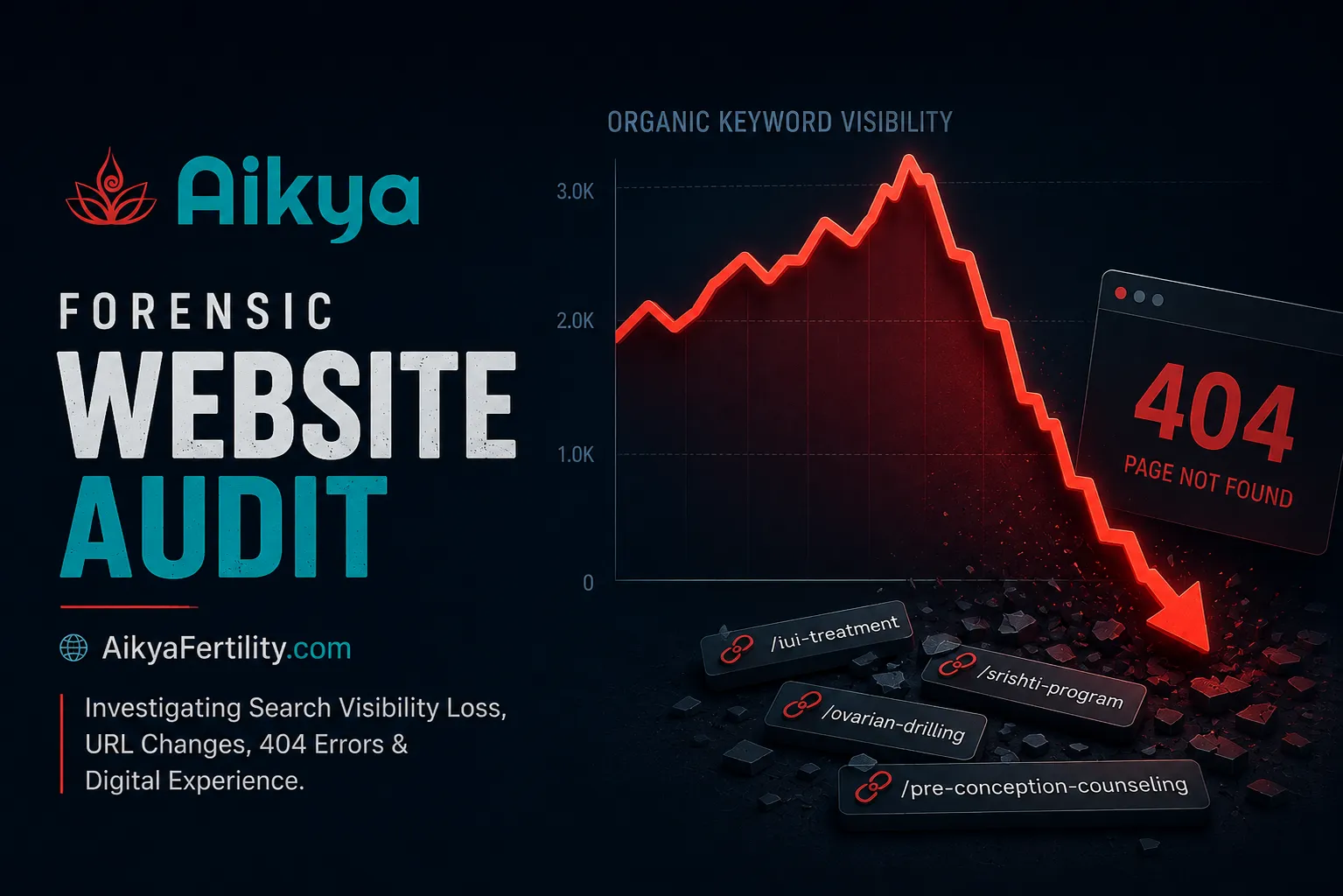
In one website investigation we conducted for a Bangalore fertility centre, we reconstructed several years of the site’s history — including changes to its URL structure, information architecture, search visibility and internal linking. The investigation found substantial architectural changes around periods of major changes in organic-search visibility. We also found unresolved legacy URLs and hundreds of internal links pointing to URLs returning 404 errors.
That doesn’t mean every ranking drop following a redesign was caused by the redesign itself. In fact, our investigation deliberately distinguishes between what the available evidence establishes and what it doesn’t.
But it illustrates an important point: when you’re paying for a website redesign, you’re not simply paying someone to make the pages look newer.
You’re paying for someone to understand what the existing website has already accumulated — its URLs, content, internal links, search visibility and conversion pathways — and to make sure those assets aren’t casually discarded during the rebuild.
We documented the complete investigation in our Aikya Fertility: A 7-Year Digital Forensic Website Investigation.
So, is a ₹15,000 website bad?
Not necessarily.
This is an important distinction.
If a small business simply wants a basic online presence and has a limited budget, a ₹15,000–₹25,000 template-based website may be completely reasonable.
But if the same business says:
“My website needs to generate leads from Google.”
or:
“Most of our new customers should come through the website.”
then the conversation changes.
If the website is a significant revenue-generating asset, it deserves to be treated like one.
A business shouldn’t spend ₹50,000 simply because someone said expensive websites are better.
It should spend more when the business outcome requires more.
The hidden cost of a cheap website
This is something I’ve encountered repeatedly over the years.
I’ve seen businesses purchase inexpensive websites, pay separately for SEO and maintenance, and then discover much later that the underlying website has significant technical or SEO problems.
Sometimes the website has been left unmaintained for years.
Sometimes outdated software, plugins or themes create security risks.
In some cases, compromised websites have ended up containing hundreds of unwanted gambling pages, casino-related links, spam content or hidden external links without the business owner even knowing it was happening.
The original website may have cost only ₹20,000 or ₹35,000.
But fixing the resulting problems can cost considerably more.
And there’s another cost that is harder to measure:
lost trust.
I’ve had numerous clients who were already frustrated with web designers and SEO companies before approaching us. They had paid one company for a website, another for SEO, perhaps another for maintenance—and still didn’t know why their website wasn’t producing results.
So the cheapest initial quote isn’t necessarily the cheapest solution over the life of the website.
What about website maintenance?
Website maintenance is often treated as an optional expense.
For a very simple website, the maintenance requirement may be relatively low.
For a WordPress website with multiple plugins, integrations, forms and third-party dependencies, maintenance becomes more important.
For e-commerce websites and custom applications, ongoing maintenance can become considerably more significant.
Think of it somewhat like accident insurance.
You don’t buy accident insurance because you expect to have an accident tomorrow.
You buy it because the financial consequences of being unprepared can be dramatically higher than the cost of staying protected.
Website maintenance works similarly.
You may not need intervention every week.
But when an update breaks something, a security vulnerability is discovered, an integration stops working or a plugin becomes incompatible, having someone responsible for the website can make a substantial difference.
We’ve inherited websites that looked fine — until we looked underneath
One of the reasons I take website maintenance seriously comes from what we’ve encountered when taking over websites from other developers.
We’ve inherited websites where everything appeared normal to the business owner. The homepage worked, the website was online and visitors could browse it.
But a deeper investigation revealed something very different: unwanted pages, injected links and spam content related to gambling and other unrelated topics had been added to the website.
In some cases, the business owner had no idea these pages existed.
This isn’t an argument against WordPress. WordPress itself is a very capable CMS. The problem is what can happen when a website is left unmanaged — particularly when outdated themes or plugins, poorly maintained third-party components, insecure installations or other technical issues are allowed to accumulate.
For a serious business, the website shouldn’t simply be something that was built once and forgotten.
It needs to be maintained, monitored and updated just like any other business asset.
That’s also why I sometimes compare website maintenance to insurance. You may go months without needing it. But when something goes wrong, you’re very glad someone is responsible for dealing with it.
What about SEO? Is SEO included in website development cost?
Usually, website development and SEO should be treated as related but separate investments.
A website can be technically well built and still require an ongoing SEO strategy to compete for valuable search terms.
The amount of SEO work required depends heavily on:
- Target location
- Industry
- Search demand
- Number and strength of competitors
- Existing website authority
- Existing backlinks
- Existing rankings
- Content quality
- Technical condition
- Search intent
- Competition within the specific niche
For example, trying to rank a local business in a relatively small city can be very different from competing for a highly competitive search such as “web design Bangalore.”
That’s why a fixed SEO package shouldn’t be treated as a magical formula.
The SEO requirements of a website should be determined by the competitive environment it is trying to enter.
And simply putting a keyword such as:
“Best IVF Center in Bangalore”
in the title tag does not magically make the website rank for that search.
Serious SEO involves understanding the websites already ranking, understanding why they rank, identifying gaps and continuously improving the target website.
It involves considerably more than inserting a keyword into a page title. As Google’s SEO guidance explains, effective SEO includes helping search engines understand your content, making pages accessible to crawlers and creating useful content for people.
SEO is a competitive process, not a checklist.
Does a more expensive website automatically rank better?
No.
Price itself is not a ranking factor.
You can spend ₹2 lakh on a beautiful website and still have terrible SEO.
You can also build a relatively modest website and achieve excellent search visibility.
What matters is what has actually been done.
A good website should provide a sound foundation for:
- Crawlability
- Indexability
- Information architecture
- Internal linking
- Content
- Performance
- Mobile usability
- Structured data where appropriate
- Conversion
- Ongoing SEO
Google’s own documentation emphasizes helpful, reliable, people-first content, good technical accessibility and overall page experience. Google also says that the same fundamental SEO practices remain relevant to AI features such as AI Overviews and AI Mode.
How much should YOUR business budget for a website?
Here’s a practical way to think about it.
If you just need an online presence
Budget: ₹25,000–₹35,000+
A simple brochure website may be enough.
If your website needs to generate leads
Budget: ₹50,000–₹1 lakh+
You should start thinking about custom UX, conversion paths, lead capture, SEO architecture, core web vitals and integrations.
If your website is an important business asset
Budget: ₹1 lakh–₹3 lakh+
The project may require substantially more planning, custom design, development, content architecture, integrations and optimization.
If you’re building e-commerce
Budget: ₹2 lakh+
And potentially considerably more depending on products, integrations and business workflows.
If you’re building a custom platform
Budget: ₹5 lakh+
At this point, you’re no longer simply buying a website. You’re commissioning a software system.
What should you ask a web design company before accepting a quote?
Don’t ask only:
“How much does a website cost?”
Ask:
1. Is the website template-based or custom designed?
2. What exactly is included in the quoted price?
3. Who owns the domain, hosting and website?
4. Will I have full administrative access?
5. Is SEO-friendly architecture included?
6. Are redirects handled if I’m redesigning an existing website?
7. What happens after the website launches?
8. Who handles security and software updates?
9. Are hosting, maintenance and third-party licenses included?
10. What happens if I want to add functionality later?
These questions can tell you much more than the headline price.
Website design cost vs website value
This is ultimately the distinction I would encourage every business owner to understand.
A website is not automatically valuable because it looks beautiful.
And it isn’t automatically bad because it was inexpensive.
The right question is:
What does this website need to accomplish for my business?
If the answer is:
“We simply need a website so people can find our address and phone number.”
Then don’t spend ₹2 lakh unnecessarily.
But if the answer is:
“Our website needs to generate enquiries, rank on Google, support our sales team and contribute significantly to our revenue.”
then the website should be treated as a serious business investment.
Saving ₹50,000 during development may sound sensible.
But if the resulting website loses search visibility, produces fewer enquiries, requires rebuilding or costs you customers over the next few years, that initial saving may turn out to be very expensive.
For a business that generates substantial revenue through its website, the opportunity cost of a poor website can be many times larger than its development cost.
So, how much does web design cost in Bangalore?
If you want the shortest possible answer:
A basic website can start around ₹25,000–₹35,000.
A professional business website typically starts around ₹50,000.
A premium custom corporate website can start around ₹1.5 lakh.
E-commerce websites can start around ₹2 lakh and go into the ₹10–15 lakh+ range for complex implementations.
Custom web applications and enterprise platforms can cost considerably more.
But don’t choose a website based solely on the number at the bottom of a quotation.
Choose it based on what you expect the website to do.
Because the most important question isn’t:
“How much does web design cost?”
It is:
“Can this website deliver what my business needs it to deliver?”
And that’s the question we believe should come before the price.
Frequently Asked Questions
How much does web design cost in Bangalore?
Web design in Bangalore can start at approximately ₹25,000–₹35,000 for a basic brochure website. Professional business websites commonly start around ₹50,000, while premium corporate websites can start around ₹1.5 lakh. E-commerce and custom web applications can cost several lakh rupees or more depending on functionality.
What is the average website development cost in Bangalore?
There is no single average that applies to every project. A simple business website may cost ₹25,000–₹35,000+, while a professional custom business website may start around ₹50,000. E-commerce, portals and custom applications can range from ₹2 lakh to ₹15 lakh or more.
How much does a 5-page website cost in Bangalore?
A five-page website can cost anywhere from approximately ₹15,000 to ₹1 lakh or more depending on whether it uses a template or custom design, the level of development involved, SEO requirements, integrations, content, lead management and other functionality.
How much does a WordPress website cost in Bangalore?
A basic WordPress website can be built for relatively little using a pre-existing theme or template. A professionally designed WordPress website with custom UI/UX, SEO-friendly architecture, custom functionality, integrations and proper maintenance can cost ₹50,000 or substantially more.
Is ₹20,000 enough for a website?
Yes, if the requirement is limited to a simple online presence and the business is comfortable with a template-based solution and limited customization. It may not be appropriate when the website is expected to be a major source of leads, organic traffic or revenue.
How much does an e-commerce website cost in Bangalore?
A serious e-commerce website can start around ₹2 lakh, but the final cost depends heavily on product catalogue complexity, payment gateways, shipping, inventory, ERP/API integrations, customer accounts, automation and custom functionality. Complex implementations can reach ₹10–15 lakh or more.
Is SEO included in website development cost?
Not necessarily. Website development and SEO are related, but they are different services. A website can be built with a strong SEO foundation, while ongoing SEO generally requires separate research, optimization, content and competitive strategy.
Is website maintenance necessary?
The amount of maintenance required depends on the technology and complexity of the website. Simple websites may require relatively little ongoing work, while WordPress sites with multiple plugins, e-commerce websites and custom applications require more regular attention to security, updates, compatibility, backups and functionality.
Final thought
When you’re buying a website, don’t ask only how much it costs. Ask whether it can deliver what it’s supposed to deliver.
/// Share this article
/// More web design reading
29 Aug 2026 · Website Forensic Audits · 26 min read
Aikya Fertility: A 7-Year Digital Forensic Website Investigation
How successive website changes, URL migrations and unresolved technical issues appear to have affected the digital performance of a Bangalore fertility centre Website investigated: Aikya Fertility & Research CentreInvest
Read article